
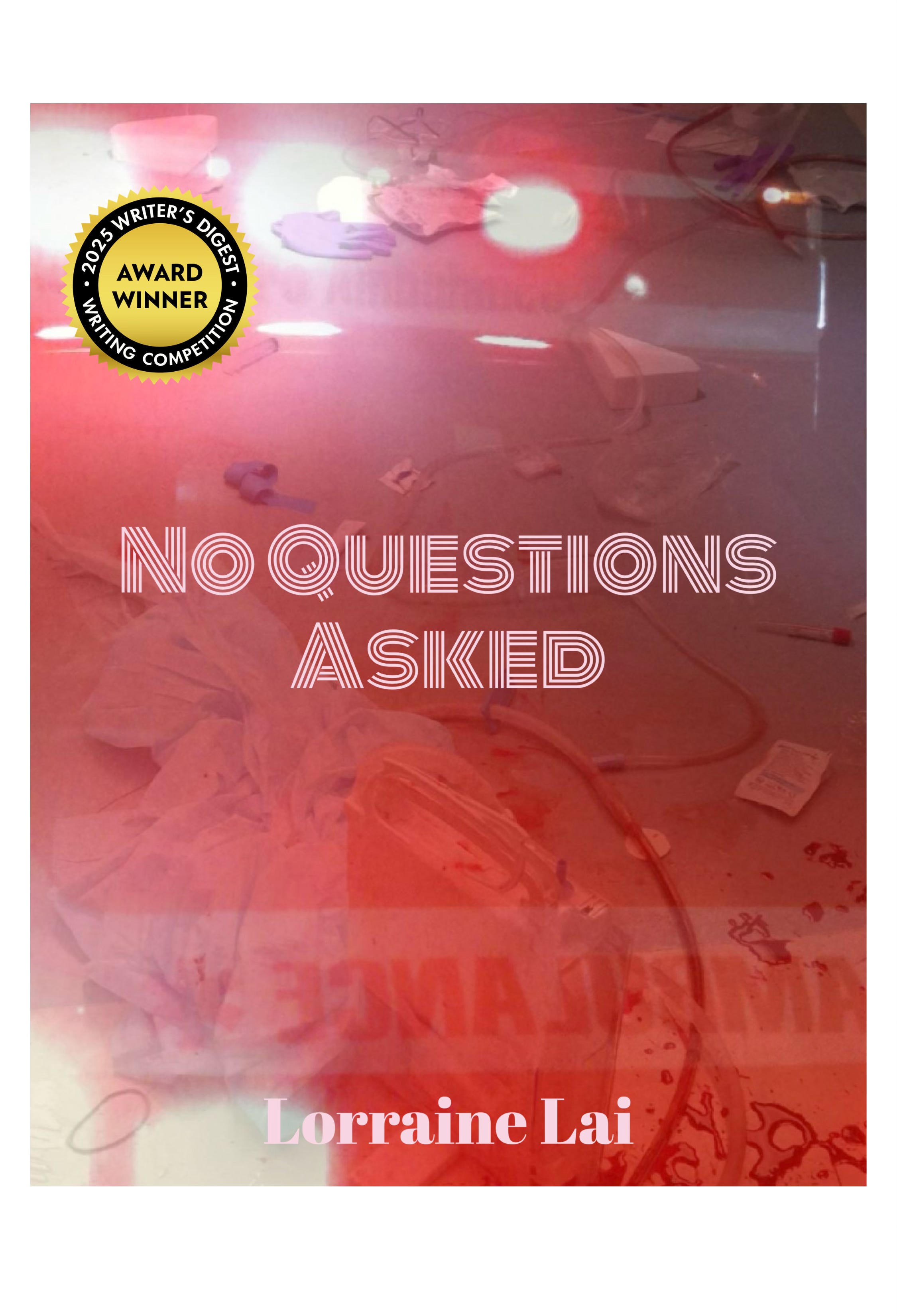
No Questions Asked

“Is the patient black or white?” the voice crackled on the phone over Kylie Minogue’s “I Should Be So Lucky” blasting from a car outside.
“I- it’s my dad. He’s having a heart attack. We need an ambulance.”
“I understand that,” she hissed in her thick Afrikaans accent, “but is he black or white?”
My answer was stuck in a three-year old flashback when I’d seen a black man die mere steps from where I was now. My father’s life hung on a thin, invisible thread connecting the tip of my tongue to the telephone line.
“Did you hear me, mesiekind? Is the patient black or white?”
“He’s neither; he’s Chinese.”
____________________
“Med 301, copy a call.”
The crackling radio extracts me from my memory. My partner looks up from a Georgia Aquarium opening flyer, “Med 301, go ahead with the call.”
“Med 301 respond to 3720 Bethsaida Road on a 9-Echo. A 65-year-old female unconscious, unresponsive. CPR in progress.”
“301 clear,” he replies while I thumb through a large mapbook.
____________________
“I cannot send a white ambulance if he’s Chinese,” her tone was cold and unapologetic.
“We are just down the street from H.F. Verwoerd Hospital,” I bit my lip to stave off tears.
“That hospital is for whites. Your father will have to go to the black hospital.”
“But it’s so far away. Where is the ambulance?”
“They will come from Kalafong.”
“Do you understand he could die while we wait for them?” my voice trembled.
“I cannot send a white ambulance. He can’t go to the white hospital. It’s the law.”
____________________
“65-year-old female, unwitnessed arrest. Her husband found her apneic and unresponsive just before calling 9-1-1,” the fire lieutenant reports as we walk through the door. “History is hypertension and diabetes. Sugar is 110. We took over CPR and are trying to get a line. No known allergies.”
“Thanks, L.T.,” I say as I walk past him to the elderly woman lying on the ground. Her white chiffon nightgown was crudely cut in the front to accommodate the AED pads on her chest.
The AED chimes, and a robotic voice announces, “Charging! Do not touch patient! Charging!” Another loud and intrusive alarm sounds, signalling that the AED is charged and ready to defibrillate. The firefighter kneeling beside the patient yells, “Clear,” and pushes the flashing shock button. The patient’s muscles contract violently, and the firefighter resumes CPR.
“How many times has she been defibrillated?” I ask, placing our cardiac monitor next to the AED.
“Once.”
A firefighter on the opposite side of the patient announces, “18 gauge, left A/C, flowing well.”
A simple nod to my partner communicates our next steps and acknowledges the unspoken truths of the countless times we merely act as witnesses when a soul moves on to their next purpose. The patient’s husband’s crying and moaning are like background noise; there, but not quite. I am aware of it, but not quite.
I realise the futility of our efforts after the patient has been intubated, given two doses of cardiac medications, and there is no change in her condition or asystolic rhythm.
“Stop CPR,” I say quietly but firmly as I snap my phone closed after conferring with Medical Control.
“My bride! My bride!” Her husband cries, rushing towards his wife’s lifeless body. He looks at me with tears streaming down his face, “Please save my bride,” he begs, coming towards me with fists balled up with all the pain and hurt trapped inside him.
“Sir, I am so sorry for your loss. We did everything we could,” the words sound hollow and lifeless to me as I utter them, “Your wife is dead.”
He looks at me, confused and scared. Grasping the collar of my uniform shirt, he screams, “No!” falling against my chest, “My bride, my bride.”
I put my arm around him and slowly guide him to an empty chair in the kitchen. “Is there someone I can call for you?” I ask, dismissing my emotions to a secret compartment in my brain that all paramedics possess but don’t speak of.
He looks up at me, the finality of the situation grimly crosses his face, “Our daughter,” he whispers and puts his head in his hands, sobbing. I place my quivering hand on his shoulder.
____________________
Despite the harsh city lights, the sky was so clear on that night three years ago; the Southern Cross was easy to spot in the purple and blue twilight hues. It was a night that ripped away my trust in humanity and forced me to witness hate; it shaped my future in many ways. It was also when I had become familiar with this “law”.
The screeching tires interrupted the soft Chinese bamboo flute music playing inside the restaurant. Then came the loud, angry car horns, followed by screaming; the kind of screaming that causes your heart to stop and mocks any bogeyman you can conjure. I ran outside in a panic to see what had happened. A small crowd had gathered; people were murmuring amongst themselves. A lady with her colourful doek was crouched next to the crumpled body of a young man moaning in pain. She comforted him in soft Sepedi words I didn’t understand. The air was filled with the coppery stench of oxidised blood as his life seeped into a puddle by his head.
“We need an ambulance,” I yelled. Some of the people turned to leave.
“He’s black,” a man muttered as he passed me.
As if those two words gave him the right to play God and decide the man’s fate, as if those two words wiped away any responsibility to help a human, as if those two words made it all alright.
Unsure of what to do, I knelt next to the man; too afraid to touch him lest I hurt him further. His breaths contrasted with my rapid, nervous breathing; his were slow, gasping, and fragmented. He opened his eyes, searching the crowd, and when they landed on mine, I saw confusion mixed with fear. “Please, someone do something!” I implored the crowd, watching his blood spill on the asphalt.
“Get out of here. It’s nothing; just a kaffir,” I heard one man say to another who looked so stricken and anxious that I could only assume he was the driver who struck the dying man. I watched as he hesitantly walked back to his car, opened the door with shaking hands, got inside, and sped away.
“He needs help,” I cried to the dissipating crowd.
A trembling hand reached across the dying man and touched mine. I looked into the tearful eyes of the woman kneeling on his other side; my eyes traced the glistening wet tracks on her brown cheeks to her mouth, which opened to say something just as I felt someone grab my arm and pull me up.
“Lorraine! Get up!” My father ferried me from the grotesque scene.
“But Dad,” I implored, “he needs help.”
“Help is on its way. There is nothing we can do,” he pulled me further away.
“Can’t we help her move him out of the street?” I cried.
“No, the police are coming, and we can’t be involved with this,” his words sounded like a blatant disregard to a call for help.
“‘Involved with this’!” My anger rose, “Helping is not being involved.”
“This is not the time for this, Lorraine,” he admonished, “The ambulance is coming, and they will take him to the hospital.”
It took them a while, but the ambulance arrived – too late. They were black. My memories are interrupted by the Afrikaans dispatcher on the phone, “The Kalafong ambulance is coming.” I heard the distinct click of the phone hanging up.
____________________
With our bellies gurgling from an onslaught of gas station hot dogs and doughnuts, we sit in an empty parking lot, waiting for another call. We have two hours left in our shift, and are grateful to have made it to this part of the night. We are superstitious in EMS and never say the five-letter word that starts with “q,” and means “without sound”, or the four-letter word that begins with “s” and is the opposite of “fast”. Instead, we just park the ambulance, settle in without speaking, and wait. I rest my head against the passenger window and close my eyes. Sleep is like eating in EMS; you do it in bite-sized portions where and when you can.
____________________
My dad’s chest pain had been so intense that he had left the restaurant to go and sit in his car. As I walked back to let him know the ambulance was coming, I tried to think of solutions that could save his life. He sat with the seat slightly reclined, his skin glistening under the street lights, his eyes closed, and his breathing more laboured than before.
“Dad, does your chest still hurt?” I asked, taking his hand into mine. He nodded.
“The ambulance is coming.”
“Thanks, sweetheart.” He opened his eyes and smiled weakly at me, squeezing my hand. “Are they coming from Kalafong?”
I slowly nodded, and he closed his eyes, shaking his head.
“So this is how it ends,” he whispered. “My papers are in the safe, Lorraine. Please tell Mommy - .”
“No, Dad!” I cut him off, “This is not how this ends. I will not tell Mommy anything; you will tell her yourself.”
With a sudden jolt, the answer came to me. It was in the foundation my father laid when he beat the racial odds and became a business owner, when he gave the apartheid laws his middle finger by opening and running a restaurant with his brother, and when he got to know and befriend influential people who enjoyed his wit and hospitality. My dad knew people, and that meant I knew them too! These were the people who were delighted that a little Chinese girl could speak fluent Afrikaans when they first met me. These were white people who could pull strings; above all, these were the white people who didn’t see my dad as anything but their friend.
“I have a plan, Dad,” I said, “I’ll be right back.”
This time, I picked up the phone with confidence and dialed my dad’s doctor.
“Hmmm,” the doctor mulled over what I had told him. I heard a shift in his voice as he took over the situation. “Don’t worry. I’ll organise a private ambulance to take him to the private hospital nearby.”
“But we’re not white.”
“They’re not government-run. Your dad will be fine.”
“Thank you so much, Oom,” I breathed a sigh of relief.
I held my dad’s hand while we waited for the private ambulance. I was terrified of losing him to a system that said someone of his colour was less, was not deserving, and was not entitled to life-saving measures. I was terrified that if he died, his death certificate would state “myocardial infarction” as the cause of death when, in fact, it should be listed as “Apartheid”.
Only when my father was safely tucked into the ambulance and on the way to the hospital did I cry. I cried out of fear for my dad’s life. I cried to release stress. And I cried for the dying young man three years ago. I learnt so much that night; mostly, I learnt what privilege is and what it can buy.
____________________
The radio crackles, “Med 301, copy a call.”
“Med 301, go ahead,” I answer.
“Med 301 copy a 9 Echo; a 72-year-old male in cardiac arrest, CPR in progress.”
My partner turns on the lights and sirens; I reach for the map book, and off we go; no questions asked.
From the Author:
I am so honoured to have received an Honorable Mention for this Memoir piece in the 94th Annual Writer’s Digest Writing Competition.
Lorraine, this is beautifully written, yet so hard to read. Thank you for sharing it with the world. And please continue to share stories like these. The world needs to know.